

Local gains are real.
Every team that adopted an AI tool can show what it saved. The improvement is genuine, measurable, and local.
© Padanet
LIVING ORGANIZATIONAL MEMORY
Padanet distills the weak signals of real work — the digital exhaust of the tools your teams already use — into a trusted, living organizational memory — so you can staff, sequence, rewire and adapt with AI on evidence instead of conviction, without turning work into surveillance.
THE BLIND SPOT
Local gains are real. Enterprise results are flat. The explanation is never where the tool was deployed — because nobody holds a current picture of how work actually flows. Transformation is steered on the annual physical when what it needs is the MRI.
Every team that adopted an AI tool can show what it saved. The improvement is genuine, measurable, and local.

Almost no organization can show the aggregate. Spend rises, delivery stays where it was, and nobody can connect the two.

The org chart describes reporting. Process documents describe an intention. Surveys describe self-report. None of them describes what is actually happening.
WHY LOCAL GAINS DO NOT COMPOUND
Giving one function a better tool improves that function. It does not improve the system the function sits inside. Five things happen instead, and the first is the only one most organizations look for.
The constraint moves.
Accelerate one step of a chain and the queue forms at the next. The local gain is entirely real; the system-level gain is not.
The surrounding process keeps human cadence.
Planning cycles, approval boards and batch handoffs were sized for how fast people work. A task that took ten days can take one while the customer still waits ten.
New steps appear.
Machine output has to be checked, grounded and owned. That work lands on people nobody staffed.
Automation makes the current design permanent.
Workarounds and redundant approvals do not fall away when a process is automated. They are encoded.
The work moves; the organization does not.
Effort and de facto ownership migrate to people the org chart does not name, and context is lost at every boundary drawn for the old distribution.
THE MRI, VERSUS THE ANNUAL PHYSICAL
Today’s instruments are the annual physical: self-reported symptoms, on a form, once a year. What is missing is the scan of the structure underneath — one that does not ask the patient what they think is wrong. Not a report, which is a picture taken once. Not a system of record, which stores what someone declared. A living memory of how the organization works, built from the work itself.
One blindness. Five places it costs you during a transformation — and five people who ask.
Padanet
“Every team can point to its own improvement.
Nobody is looking at the whole.”
95%
Of enterprise generative-AI pilots show no measurable P&L impact
MIT NANDA, The GenAI Divide: State of AI in Business 2025, July 2025
Only 21%
Have fundamentally redesigned at least some workflows for AI
McKinsey / QuantumBlack, The State of AI, March 2025
Only 8%
Have reliable data on the skills their workforce actually has
Gartner HR Research, September 2024
WHAT PADANET IS
Weak signals from the systems you already own — tickets, commits, documents, calendars — distilled into a governed memory of process, collaboration, capability, cost and access. Read by leaders, by the people who opt in, and by the agents you already run, under one set of scope rules.
In the analyst’s vocabulary: an AI context platform at the organizational layer — a context graph of how this company actually works, rather than of its data or its tools.
Corporate data first
No survey, no timesheet
No new tool to adopt
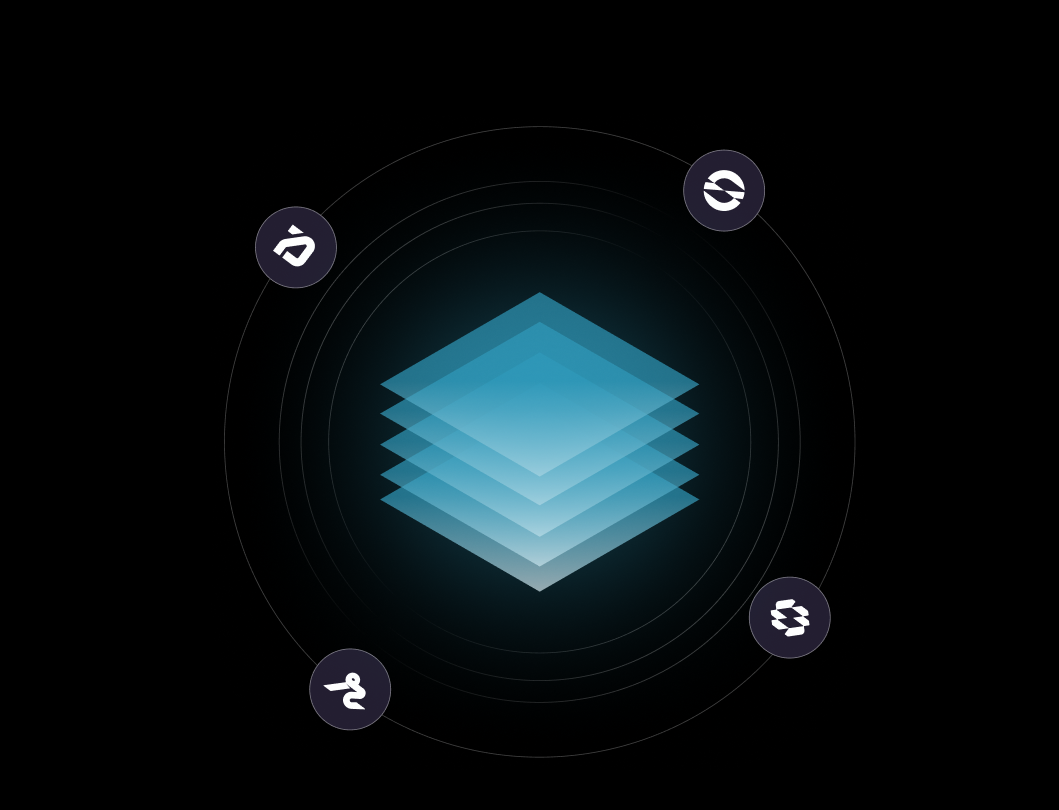
THE LOOP
Weak signals distilled into memory, missions that act on it, and a view of what changed since last time.
Weak signals from the systems your company already owns — tickets, commits, documents, calendars — read purpose-bound and read-only. Not content. Patterns.
Bounded analyses that act on the memory for one decision: where is the delivery chain loaded, where did the constraint go, what does this program really need.
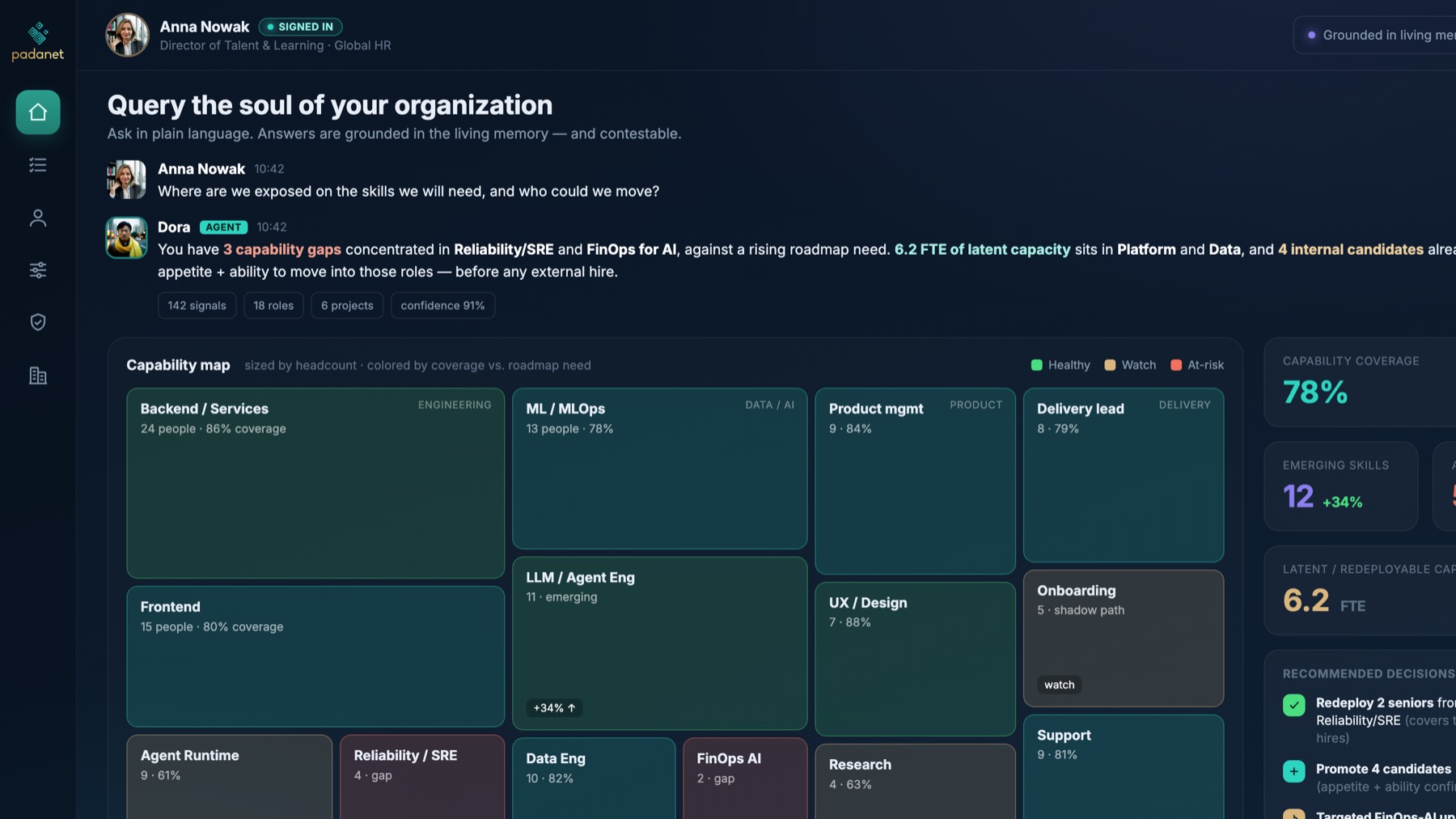
What changed since last time. The memory has a present tense — the constraint that moved, the dependency that formed, the capability that emerged — and you read it without a data team.
THREE DOORS
Leaders read it through PadaMaster, people read their own through PadaOne, and the agents you already run read it directly. Three independent doors onto one memory, each under the same scope and sharing rules.
Built on corporate data your company already owns. Nothing is asked of an employee before anything is offered. Where the delivery chain is loaded, where the constraint moved, whether capability is where the business is heading — each answer with the evidence it rests on.
 Corporate data only — nothing asked of an employeeRead-only connectors to systems you already ownAggregated answers, with the evidence attachedA diagnosis and recommendations you can open
The memory read by the person, for the person — their own memory of their work: theirs, shared only by their choice, and never merged into the organization’s without it. Opt-in, consented, correctable, and never the price of entry. We help individuals build that memory and carry context from one job to the next. To join the early adopters list, get in touch.
Opt-in, always — never the price of entryEach person sees their own picture firstCorrectable, and revocableSkills as a consented output, not the frame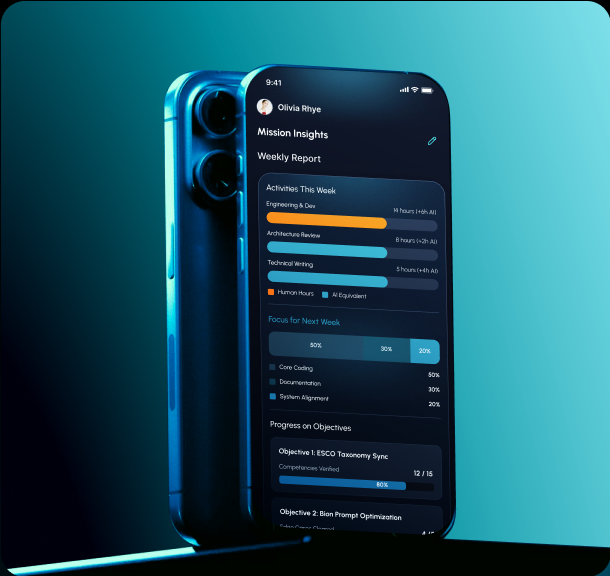
Your agents already need to know how the organization works. An agent asks for context for a declared purpose and receives a context packet: the smallest adequate, authorized, current, evidence-backed set of claims for that task. Foundations says what exists today.
A context packet for a declared purposePurpose-bound access compiled in, not filtered afterDesigned to be served over an API and over MCPProposals back into the memory pass governance first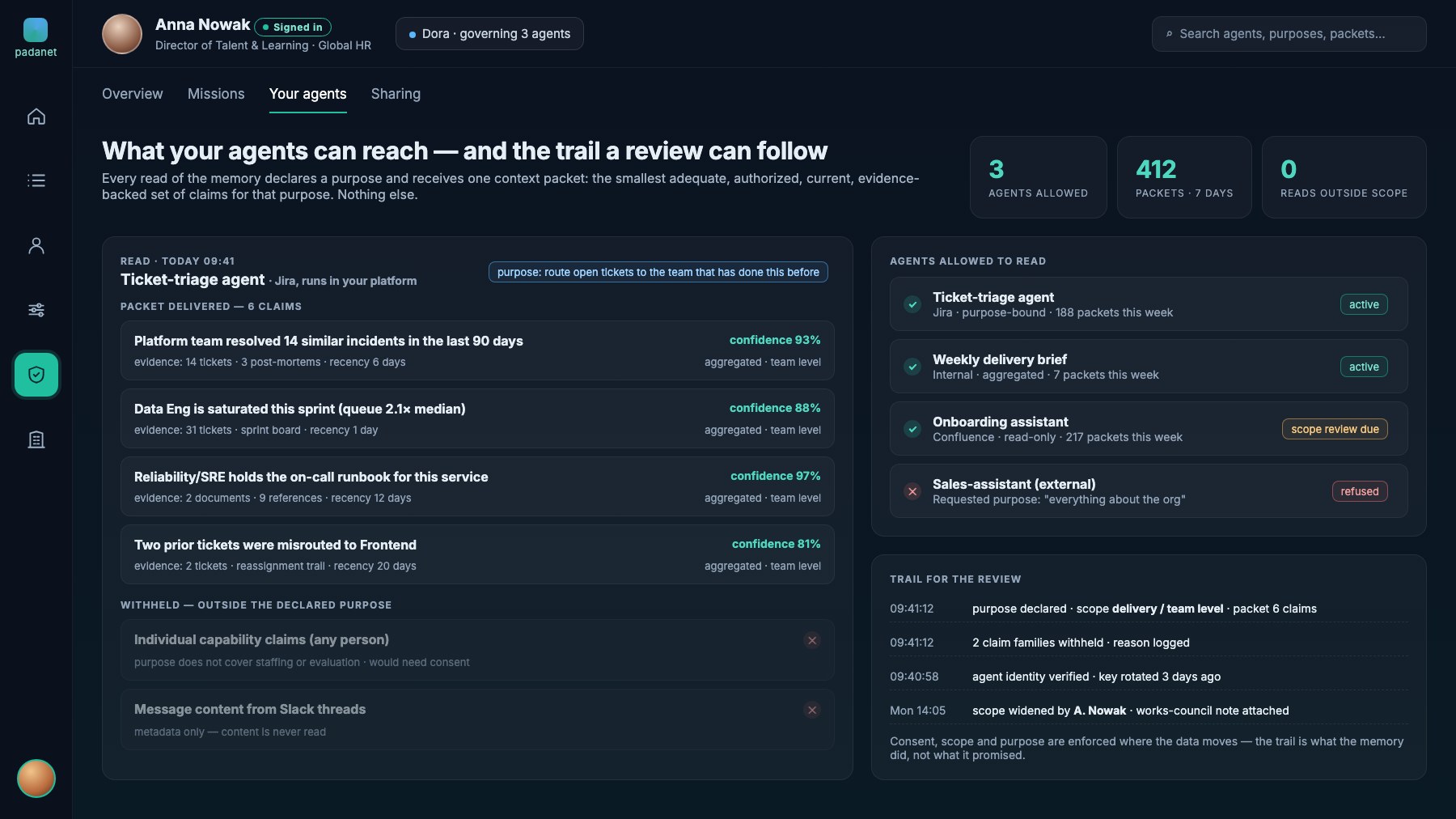
WHO ASKS WHAT
Five readings of one memory, inside the same transformation. Where capability appears in a leader's answer, it appears as evidence the organization can inspect — never as a profile of a person.
Spend rises, delivery stays flat, and nobody can connect the two.
Where the gain from the last pilot actually went — and which step to accelerate next. The memory holds the baseline and the after, so the answer rests on evidence rather than on the vendor's claim.
Delivery leaderWork migrates toward people the org chart does not name, and requests die in routing nobody designed.
Where work queues, which handoff is costing the most, which team sits on the critical path of work it is not resourced for — read continuously, not reconstructed by hand once a quarter.
People and talent leaderPeople are known for the last thing they did loudly, not for what they can do.
Which capability the work is actually building, and where it is thinning — read from evidence of work rather than from declarations, and never as a profile of a person.
Security and compliance leaderThe organization now runs agents it did not write, on data it must answer for.
What the memory holds, who and which agent can read it, for which declared purpose — and the trail a review can follow. Consent, scope and purpose enforced where the data moves, not promised in a document.
An employee — by consentThe transformation is happening to their role, and nobody has shown them the picture.
Where their time goes and where their trajectory is heading — visible to the person first, correctable by them, and shared only as far as they decide. PadaOne is their own door into the same memory, opt-in and never the price of entry.
HONEST QUESTIONS
No — and the answer is in the architecture, not in a promise. PadaMaster reads corporate systems the company already owns, not people: tickets, commits, documents, calendars, and patterns rather than content. Outputs to the organization are aggregated. Every access names a purpose and is compiled against it, so a claim usable for staffing is not usable for a performance review. The individual layer, PadaOne, is opt-in, visible to the person first, and correctable by them. Nobody is ranked, scored or watched.
No. It informs decisions; people make them. Nothing on this site or in the product implies hiring, firing, staffing or evaluation without human judgment and accountability.
As one consented output of the memory — not the category. The memory spans capability, collaboration and process; capability is one reading of it, shown as claims with evidence and recency rather than as a skills database, and, where it concerns a person, consented and contestable.
No. Padanet reads from the systems you own and enriches what they hold. It replaces none of them; an HRIS holds declared roles, the memory holds observed work, and the two are complementary.
AFTER THE PROGRAMME
Every transformation programme has a start and a declared finish. What it leaves behind is usually a slide deck and a set of decisions nobody can retrace. The memory is what remains: still current, still evidence-backed, and still answering the same questions a year later — so the next change is steered rather than argued.
That is the difference between a report and a memory. A report is a picture taken once. A memory keeps reading the work, so the organization does not go blind again the moment the programme closes.
Padanet is built with a first circle of design partners who steer on evidence. Bring a decision you cannot currently make with the evidence you have: that is where the conversation starts, and there is something to see.